


- University
- Academic
- Schools/Vocational Schools
- Vocational School of Justice
- Vocational School
- Vocational School
- Department of Banking and Insurance (Turkish)
- Department of Computer Programming (Turkish)
- Department of Foreign Trade (Turkish)
- Department of Graphic Design (Turkish)
- Department of Interior Design (Turkish)
- Department of Construction Technology (Turkish)
- Department of Occupational Health and Safety (Turkish)
- Department of Media and Communication (Turkish)
- Department of Architectural Restoration (Turkish)
- Department of Radio and Tv Programming (Turkish)
- Department of Civil Aviation Cabin Services (Turkish)
- Department of Civil Aviation Transportation Management (Turkish)
- Department of Tourism and Hotel Management (Turkish)
- Department of Applied English Translation
- Vocational School Of Health Services
- Vocational School Of Health Services
- Department of Child Development (Turkish)
- Department of Physiotherapy (Turkish)
- Department of Paramedic (Turkish)
- Department of Opticianry (Turkish)
- Department of Medical Documentation and Secreteriat (Turkish)
- Department of Medical Imaging Techniques (Turkish)
- Department of Medical Laboratory Techniques (Turkish)
- Department of Elderly Care (Turkish)
- School of Applied Management Sciences
- School of Foreign Languages
- Faculties
- Faculty of Arts and Sciences
- Faculty of Fine Arts and Design
- Faculty of Law
- Faculty of Communication
- Faculty of Business
- Faculty of Engineering
- Faculty of Engineering
- Department of Computer Engineering
- Department of Biomedical Engineering
- Department of Electrical and Electronics Engineering
- Department of Industrial Engineering
- Department of Food Engineering
- Department of Genetics and Bioengineering
- Department of Aerospace Engineering
- Department of Civil Engineering
- Department of Mechanical Engineering
- Department of Mechatronics Engineering
- Department of Software Engineering
- Faculty of Health Sciences
- Medicine
- Graduate School
- Common Courses
- Schools/Vocational Schools
- Research
- Research Centers
- Library
- Smart Campus
- Technology Transfer Office
- İzmir Sciencepark
- Continuous Education Center (EKOSEM)
- Children's University
- Ethics Committee
- Teaching and Learning Center (EKOEĞİTİM)
- Psychology Application and Research Center
- Researcher Training Coordinatorship
- Research Collaborations And Innovation Coordinatorship
- Campus
- INTERNATIONAL
- Contact
- 25TH YEAR
Department of Computer Engineering
CE 345 | Course Introduction and Application Information
| Course Name |
Introduction to Machine Learning
|
|
Code
|
Semester
|
Theory
(hour/week) |
Application/Lab
(hour/week) |
Local Credits
|
ECTS
|
|
CE 345
|
Fall/Spring
|
3
|
0
|
3
|
5
|
| Prerequisites |
None
|
|||||
| Course Language |
English
|
|||||
| Course Type |
Elective
|
|||||
| Course Level |
First Cycle
|
|||||
| Mode of Delivery | - | |||||
| Teaching Methods and Techniques of the Course | DiscussionProblem SolvingQ&ALecture / Presentation | |||||
| National Occupation Classification | - | |||||
| Course Coordinator | ||||||
| Course Lecturer(s) | ||||||
| Assistant(s) | - | |||||
| Course Objectives | The field of machine learning is concerned with the question of how to construct computer programs that improve automatically with experience. In recent years, many successful applications of machine learning have been developed, ranging from data-mining programs that learn to detect fraudulent credit card transactions, to autonomous vehicles that learn to drive on public highways. At the same time, there have been important advances in the theory and algorithms that form the foundation of this field. The goal of this course is to provide an overview of the state-of-art algorithms used in machine learning. Both the theoretical properties of these algorithms and their practical applications will be discussed. |
| Learning Outcomes |
The students who succeeded in this course;
|
| Course Description | Machine learning is concerned with computer programs that automatically improve their performance with past experiences. Machine learning draws inspiration from many fields, artificial intelligence, statistics, information theory, biology and control theory. The course will cover the following topics; computational learning theory, machine learning concepts, Bayesian learning, supervised learning, classification methods, regression methods, unsupervised learning, clustering methods, artificial neural networks, reinforcement learning, and discussion of advanced machine learning methods. |
| Related Sustainable Development Goals |
|
|
|
Core Courses | |
| Major Area Courses |
X
|
|
| Supportive Courses | ||
| Media and Management Skills Courses | ||
| Transferable Skill Courses |
WEEKLY SUBJECTS AND RELATED PREPARATION STUDIES
| Week | Subjects | Related Preparation |
| 1 | Introduction to Data Science with Python | Grus, Ch.s 2--6 |
| 2 | Introduction and Machine Learning Concepts | Alpaydın, Ch.1 |
| 3 | Bayesian Decision Theory and Classification | Alpaydın, Ch.3 |
| 4 | Supervised Learning - Parametric Classification Methods | Alpaydın, Ch.s 2, 10; Goodfellow et al, Ch. 5.5 |
| 5 | Supervised Learning - Non-parametric Classification Methods | Hastie et al, Ch. 13 |
| 6 | Supervised Learning - Regression Methods | Weisberg, Ch. 2 |
| 7 | Machine Learning Metrics | Various articles and studies |
| 8 | Midterm Exam | |
| 9 | Unsupervised Learning - Clustering Methods | Alpaydın, Ch. 7; Geron, Ch. 9 |
| 10 | Unsupervised Learning - Clustering Methods | Geron, Ch. 9; Murphy, Ch.s 25.3, 25.4, 25.5 |
| 11 | Unsupervised Learning - Neural Networks | Bishop, Ch. 5; Alpaydın, Ch. 11; Hastie et al, Ch. 11 |
| 12 | Unsupervised Learning - Neural Networks | Bishop, Ch. 5; Alpaydın, Ch. 11; Hastie et al, Ch. 11 |
| 13 | Reinforcement Learning | Alpaydın, Ch. 18 |
| 14 | Reinforcement Learning and Advanced Machine Learning Methods | Alpaydın, Ch.s 11, 18; Goodfellow et al, Ch.s 6, 7, Murphy, Ch. 28 |
| 15 | Semester review | |
| 16 | Final Exam |
| Course Notes/Textbooks | Alpaydın, E. (2014), Introduction to Machine Learning. The MIT Press, ISBN-13: 978-0-262-028189 |
| Suggested Readings/Materials | Grus, J. (2019). Data science from scratch: first principles with python. O'Reilly Media, ISBN: 9781492041139 Murphy, K. P. (2012). Machine learning: a probabilistic perspective. MIT press, ISBN-13: 978-0262018029 Mitchell, T. M. (1997). Machine Learning. McGraw-Hill, ISBN: 0070428077 Bishop, C. M. (2006). Pattern recognition and machine learning. Springer, ISBN-13: 978-0387-31073-2 Hastie, T., Tibshirani, R., Friedman, J. H., & Friedman, J. H. (2009). The elements of statistical learning: data mining, inference, and prediction. Springer, ISBN-13: 978-0-387-84857-0 Géron, A. (2022). Hands-on machine learning with Scikit-Learn, Keras, and TensorFlow. O'Reilly Media, Inc., ISBN-13: 9781492032649 Weisberg, S. (2014). Applied linear regression. Wiley, ISBN-13: 9780471663799 Goodfellow, I., Bengio, Y., Courville, A. (2016). Deep learning. MIT Press, ISBN-13: 978-0262035613 |
EVALUATION SYSTEM
| Semester Activities | Number | Weigthing |
| Participation | ||
| Laboratory / Application | ||
| Field Work | ||
| Quizzes / Studio Critiques |
6
|
30
|
| Portfolio | ||
| Homework / Assignments | ||
| Presentation / Jury | ||
| Project | ||
| Seminar / Workshop | ||
| Oral Exams | ||
| Midterm |
1
|
30
|
| Final Exam |
1
|
40
|
| Total |
| Weighting of Semester Activities on the Final Grade |
7
|
60
|
| Weighting of End-of-Semester Activities on the Final Grade |
1
|
40
|
| Total |
ECTS / WORKLOAD TABLE
| Semester Activities | Number | Duration (Hours) | Workload |
|---|---|---|---|
| Theoretical Course Hours (Including exam week: 16 x total hours) |
16
|
3
|
48
|
| Laboratory / Application Hours |
16
|
0
|
|
| Study Hours Out of Class |
14
|
4
|
56
|
| Field Work |
0
|
||
| Quizzes / Studio Critiques |
6
|
2
|
12
|
| Portfolio |
0
|
||
| Homework / Assignments |
0
|
||
| Presentation / Jury |
0
|
||
| Project |
0
|
||
| Seminar / Workshop |
0
|
||
| Oral Exam |
0
|
||
| Midterms |
1
|
14
|
14
|
| Final Exam |
1
|
20
|
20
|
| Total |
150
|
COURSE LEARNING OUTCOMES AND PROGRAM QUALIFICATIONS RELATIONSHIP
|
#
|
Program Competencies/Outcomes |
* Contribution Level
|
|||||
|
1
|
2
|
3
|
4
|
5
|
|||
| 1 |
To have adequate knowledge in Mathematics, Science and Computer Engineering; to be able to use theoretical and applied information in these areas on complex engineering problems. |
-
|
-
|
-
|
-
|
-
|
|
| 2 |
To be able to identify, define, formulate, and solve complex Computer Engineering problems; to be able to select and apply proper analysis and modeling methods for this purpose. |
-
|
-
|
X
|
-
|
-
|
|
| 3 |
To be able to design a complex system, process, device or product under realistic constraints and conditions, in such a way as to meet the requirements; to be able to apply modern design methods for this purpose. |
-
|
-
|
-
|
-
|
-
|
|
| 4 |
To be able to devise, select, and use modern techniques and tools needed for analysis and solution of complex problems in Computer Engineering applications; to be able to use information technologies effectively. |
-
|
-
|
-
|
-
|
X
|
|
| 5 |
To be able to design and conduct experiments, gather data, analyze and interpret results for investigating complex engineering problems or Computer Engineering research topics. |
-
|
-
|
X
|
-
|
-
|
|
| 6 |
To be able to work efficiently in Computer Engineering disciplinary and multi-disciplinary teams; to be able to work individually. |
-
|
-
|
-
|
-
|
-
|
|
| 7 |
To be able to communicate effectively in Turkish, both orally and in writing; to be able to author and comprehend written reports, to be able to prepare design and implementation reports, to present effectively, to be able to give and receive clear and comprehensible instructions. |
-
|
-
|
-
|
-
|
-
|
|
| 8 |
To have knowledge about global and social impact of Computer Engineering practices on health, environment, and safety; to have knowledge about contemporary issues as they pertain to engineering; to be aware of the legal ramifications of Computer Engineering solutions. |
-
|
-
|
-
|
-
|
-
|
|
| 9 |
To be aware of ethical behavior, professional and ethical responsibility; to have knowledge about standards utilized in engineering applications. |
-
|
-
|
-
|
-
|
-
|
|
| 10 |
To have knowledge about industrial practices such as project management, risk management, and change management; to have awareness of entrepreneurship and innovation; to have knowledge about sustainable development. |
-
|
-
|
-
|
-
|
-
|
|
| 11 |
To be able to collect data in the area of Computer Engineering, and to be able to communicate with colleagues in a foreign language. ("European Language Portfolio Global Scale", Level B1) |
-
|
-
|
-
|
-
|
-
|
|
| 12 |
To be able to speak a second foreign language at a medium level of fluency efficiently. |
-
|
-
|
-
|
-
|
-
|
|
| 13 |
To recognize the need for lifelong learning; to be able to access information, to be able to stay current with developments in science and technology; to be able to relate the knowledge accumulated throughout the human history to Computer Engineering. |
-
|
-
|
-
|
-
|
-
|
|
*1 Lowest, 2 Low, 3 Average, 4 High, 5 Highest

NEWSALL NEWS


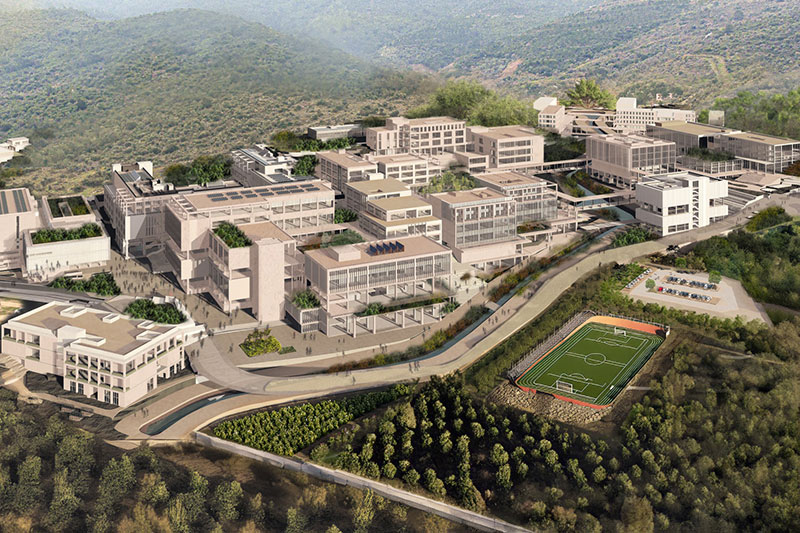
IZMIR UNIVERSITY OF ECONOMICS GÜZELBAHÇE CAMPUS
DetailsGLOBAL CAREER
As Izmir University of Economics transforms into a world-class university, it also raises successful young people with global competence.
More..CONTRIBUTION TO SCIENCE
Izmir University of Economics produces qualified knowledge and competent technologies.
More..VALUING PEOPLE
Izmir University of Economics sees producing social benefit as its reason for existence.
More..
You are one step ahead with your graduate education at Izmir University of Economics.